





| Home > Vietnam > Vietnam visa information for partners > Vietnam visa on arrival |

Visa on arrival is the most comfortable way to obtain Vietnam visa without wasting time. This is a letter approved by Vietnam Immigration Department, which allows traveler to enter and exit Vietnam for a given period. With approval letter for visa on arrival, traveler can only get Vietnam visa stamped at Vietnam international airports (Noi Bai in Hanoi, Tan Son Nhat in Ho Chi Minh City and Da Nang airport in Da Nang City).
Visa on arrival is officially issued by Vietnam Immigration Department (Vietnamese Government Agent), it has same validity with the visa get from Vietnamese embassy abroad.
After getting the approval letter form Immigration office, we will send you the copy by e-mail. Another copy of the same document will be transmitted to Vietnam immigration checkpoints at International Airports, so that when your customer arrive in Vietnam, the Immigration officers will have those documents on hand and will be able to issue his/her entry visa.
To get Vietnam visa stamped on passport your customers need to bring:
- Passport (with validity at least 6 months and have a blank page for visa stamped)
- 2 passport–size photos (4 x 6 cm).
- Copy of approval letter that we sent to you.
- Stamping fee, your customers pay directly in cash at the Immigration desk at airport.
- To save time at Vietnam airport, please ask your customers download and fill in this form in advance. Photos and signatures are required.
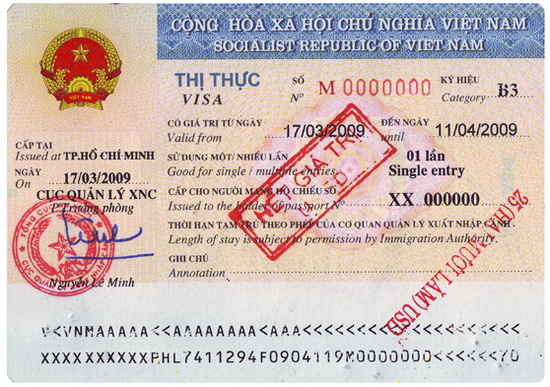
A Vietnam visa on arrival issued at Tan Son Nhat International airport, Ho Chi Minh City (Saigon), Vietnam
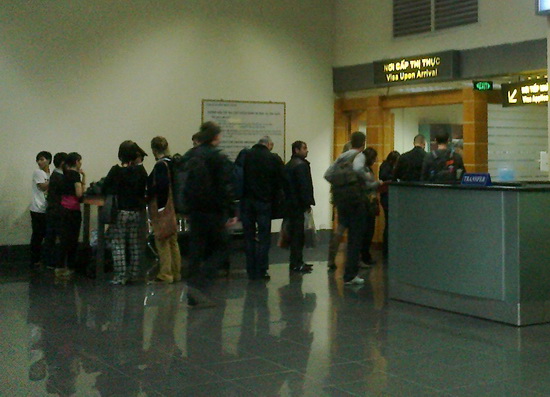
Travelers are getting visa
on arrival at Noi Bai airport (24/7 service)
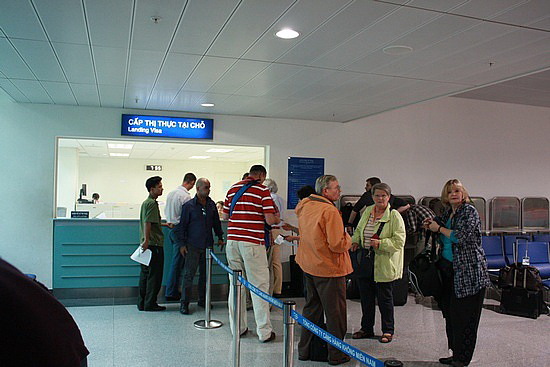
Travelers are getting visa
on arrival at Tan Son Nhat airport (24/7 service)
Notes on photo:
- Photographs must be identical, taken within the past 6 months.
- The image size from the bottom of the chin to the top of the head should be between 1 inch and 13/8 inches.
- The photographs may be in color or black and white.
- The photo must be full face, front view with a plain white or off-white background.
- Photographs should be taken in normal street attire, without a hat or headgear that obscures the hair or hairline.
- Uniforms should not be worn in photographs with the exception of religious attire which is worn daily.
- If prescription glasses, a hearing device, wig or similar articles are normally and consistently worn, they should be worn when the picture is taken.
- Dark glasses or nonprescription glasses with tinted lenses are not acceptable unless required for medical reasons. A medical certificate may be required to support the wearing of such glasses in the photographs.

High Quality Tour Service:
 Free consultancy
Online communication
Affordable, refundable
Customized service
Flexible, changeable
Interaction with locals
Authentic experience
Deposit, pay on arrival
Clear cancellation term
Free consultancy
Online communication
Affordable, refundable
Customized service
Flexible, changeable
Interaction with locals
Authentic experience
Deposit, pay on arrival
Clear cancellation term
 ... I cannot thank you enough for our three week tour in Vietnam
which included a few days in Cambodia ...
... I cannot thank you enough for our three week tour in Vietnam
which included a few days in Cambodia ... 
Roy, Spain
...
Thank you for a great trip in the north of Vietnam! It was really
good and everything was organized so good! ... Fransesca, Netherlands

A member of Vietnam Travel Promotion Group (VTP Group)
Address: Room 509, 15T2 Building, 18 Tam Trinh Str., Hai Ba Trung District, Hanoi, Vietnam (See map)
Tel: +84.24.62768866 / mail[at]tuanlinhtravel.com
Visited: 1967

